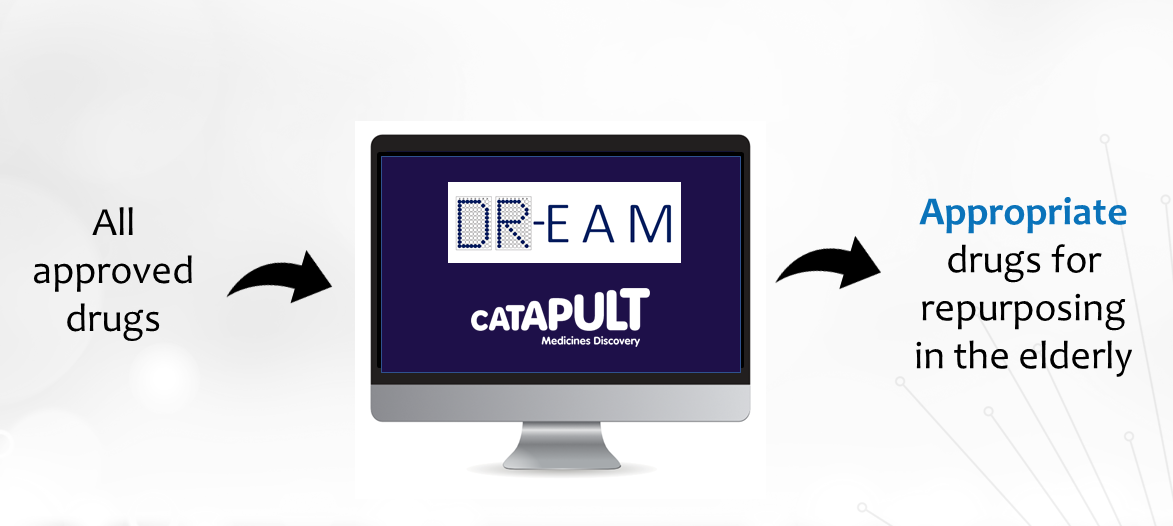
Drug repositioning for the elderly and DR-EAM:
Drug Repositioning, the use of an approved drug in an alternative or unexpected therapeutic indication, can be a highly efficient way to discover new medicines. However, not all approved drugs are created equal, with differing dosage routes, safety and side effect profiles, or varied interactions with other medicines, etc. Similarly, not all patients are created equal, with individual and population-level pharmacogenetic variations, range of underlying co-morbidities, polypharmacy and differences in weight, and other key physiological parameters.
In particular, for an elderly population there are several factors that need careful consideration before repositioning an existing drug into an elderly patient group. Elderly patients tend to be multi-medicated already, can often have impairment of liver and kidney function, along with disruption of the blood-brain-barrier; factors which make safety a key concern for use of drugs in these patient populations. Additional specific factors can also come into play, for instance the heightened risk of infection from parenteral dosing of drugs, dosing frequency and compliance, heightened risk of side effects such as confusion, and finally the potential adverse consequences of drug-drug interactions in a polypharmacy setting.
There is also a set of practical constraints that govern repositioning as part of a healthcare system, for example, controlled substances would be impossible, as would very high-cost drugs when aiming for widespread application.
As part of a UK-SPINE funded project we have assembled relevant data to allow selection of drugs for repositioning based on application of a series of filters relevant to efficacy, tolerability and safety in an elderly population (www.dr-eam.ai). We see the data as providing a framework and prioritised set of drugs for repositioning in an elderly and multimorbid patient group, and also allowing the identification of potential issues and consideration of all approved drugs.